Computers and Cardiology: UMMS, PKUHSC researchers exploring better ways to diagnose heart failure
A research team from Peking University Health Science Center (PKUHSC) was recently in Ann Arbor to advance a collaboration putting computers to work identifying different kinds of heart failure.
12:00 PM
Author |
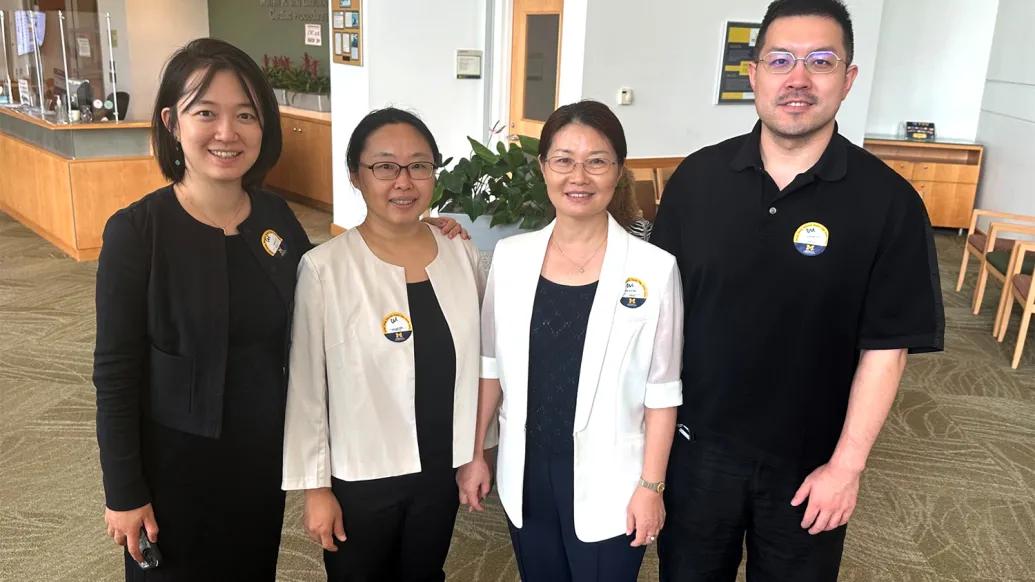
Baoxia Chen, MD, Professor of Medicine and Director of Heart Failure Program at Peking University Third Hospital, led a group of her colleagues to Michigan Medicine in August to meet with collaborators Scott Hummel and Daniel Beard. The group is working on a study that deploys artificial intelligence to better identify certain common—but complex—underlying causes of heart failure. The team garnered funding from the Michigan Medicine-PKUHSC Joint Institute for the project in 2022 and has hosted many virtual meetings, but the visit in August marked their first in-person gathering.
Heart failure with preserved ejection fraction, or HFpEF, is the diagnosis when a patient experiences familiar symptoms—shortness of breath, fatigue—but tests show normal or near-normal pumping function of the heart, as assessed by its ejection fraction: the percentage of blood in the left ventricle of the heart that is ejected during each beat.
HFpEF accounts for about half of all heart failure cases. Yet, despite being commonplace, it can be difficult to treat because the underlying causes are complicated and varied. The condition is associated with wide range of comorbidities, from diabetes and obesity to coronary artery disease.
“With HFpEF, there are a lot of different categories. With standard tests, it’s hard to figure out which subset of challenges a person has,” said Hummel, Associate Professor of Internal Medicine and Director of Michigan Medicine’s HFpEF program.
Drilling down into those categories often involves a variety of clinical tests, some of them invasive and costly. But what if a computer, given basic clinical input like imaging measurements and biometric data, could help determine which variety of HFpEF a patient was suffering from?
Hummel and Beard, UMMS Carl J. Wiggers Collegiate Professor of Cardiovascular Physiology, have developed computer models that employ machine learning to categorize HFpEF, effectively applying the latest in artificial intelligence technology to a growing health problem; one recent national study showed that the proportion of patients hospitalized with heart failure who had preserved ejection fraction has increased steadily over time, from 33% in 2005 to 39 % in 2010.
“Applying physiology-informed machine learning techniques to better classify HFpEF is completely novel. It’s never been done,” said Beard, PhD, whose lab developed the initial computer models. “The symptoms are non-specific, but by taking data you measure in the clinic—blood pressure, oxygen levels, blood flow volumes and rates—you can in principle interrogate the specific underlying causes taking place inside the body.”
A presentation of this work at a 2022 cardiovascular JI seminar caught the attention of Yida Tang, Chief of Cardiology at Peking University Third Hospital, planting the seeds for a collaboration. Their project expands on the work begun at UMMS in important ways. First, it will bring more—and more diverse—patients into the study.
Second, the PKUHSC team will be the first to apply the models prospectively to new patients. Dr. Tang’s team has been developing protocols to put patients through exercise stress tests and plug the resulting data into the model, an important step forward.
If successful, the work could make a meaningful difference for a huge number of patients—more than 3 million a year in the US alone – who are currently living with HFpEF.
“The scope of the problem is large. There is a huge group of patients who come to us feeling just terrible and often we’re not quite sure what to do about it,” Hummel said. “This presents potentially important new ways of looking at and approaching the issue.”
Featured News & Stories

Students ponder differences, shared challenges during visit to China
How AI is helping emergency physicians learn from their patients

A link between e-cigarettes and oral cancer
Research may help better predict outcomes in kids with congenital cytomegalovirus

Global REACH awards support new collaborations in Ecuador, Ghana and Kenya