Joseph Wider, PhD

Department of Emergency Medicine
E. Medical Center Dr
Ann Arbor, Michigan 48109
Manage Your Profile
About
Dr. Wider’s lab studies the role of mitochondria in the brain. Mitochondria are central to normal brain function but are recognized as a common component in acute brain injuries, such as traumatic brain injury, ischemic stroke, cardiac arrest and neonatal hypoxic ischemic encephalopathy. Dr. Wider studies the molecular mechanisms of mitochondrial dysfunction and the causal relationship with the pathogenesis of injury. Using in vitro, preclinical and translational models, the Wider lab is focused on expanding our understanding of brain injury and developing therapies that improve neurological outcomes.
Qualifications
-
Research FellowUniversity of Michigan, Emergency Medicine, Ann Arbor, 48109, United States
2017 - 2021
Postdoctoral Fellowship
-
Research FellowWayne State University, Emergency Medicine, Detroit, United States
2017 - 2017
Postdoctoral Fellowship
-
PhD, PhysiologyWayne State University, Department of Physiology, Detroit, MI, United States
2011 - 2017
-
B.S., PhysiologyMichigan State University, Department of Physiology, East Lansing, MI, United States
2003 - 2008
Center Memberships
-
Center MemberWeil Institute for Critical Care Research
Research Overview
My lab studies the role of mitochondria in the brain. Specifically we are interested in how dysfunction of mitochondria contribute to progressive and delayed cell death after acute injuries, like stroke, cardiac arrest and neurotrauma.
My research is focused on exploring how mitochondria become dysfunctional. Energy production in the brain relies almost exclusively on oxidative phosphorylation, making mitochondria critically important for cell function. Regulating mitochondrial function and maintenance are critical to maintaining the ability to efficiently produce enough energy for all the cells in the brain to function. Mitochondrial dynamics, mitophagy and biogenesis are the primary mechanisms that regulate mitochondrial maintenance. We are studying how dysfunction of these systems contribute to cellular dysfunction and tissue damage in brain injury.
Based on our mechanistic research, we are developing mitochondrial targeted therapeutics in preclinical and translational models of acute brain injury. These technologies include non-invasive mitochondrial modulation, intranasal drug administration, intranasal cooling and gene therapy.
Recent Publications
-
Emaus KJ, Fogo GM, Raghunayakula S, Gruley E, McCracken L, Dubs C, Speas RL, Torres Torres FJ, Wider JM, Sanderson TH. Journal of Cerebral Blood Flow and Metabolism, 2026 Aug 1; 46 (8): 2138 - 2152.Journal ArticleCross-species evidence for cardiolipin remodeling in neonatal hypoxic–ischemic encephalopathy
DOI:10.1177/0271678X261435368 PMID: 41914681 -
White BC, Sullivan JM, Paxton JH, Sanderson TH, Wider JM, Lagina AT, O’Neil BJ. Resuscitation Plus, 2026 May 1; 29:Journal ArticleNarrative review of rationale for IV deferoxamine plus intranasal insulin to ameliorate brain damage following resuscitation from cardiac arrest
DOI:10.1016/j.resplu.2026.101345 -
Li Y, Neuffer SJ, Wider J, Ma S, Zhao N, McCracken L, Sanderson T, Dong J-F, Deng Y, Xiao Y. 2026 Apr 1;PreprintOmicGlaze: Spatial Multi-Omic Mapping of Traumatic Brain Injury.
DOI:10.64898/2026.03.30.715462 PMID: 41959485 -
Wider J. 2025 Nov 2;PresentationBrain Injury and the Mechanistic Role of Mitochondria
-
Speas R, Raghunayakula S, Torres-Torres F, Eamus K, Sanderson T, Wider J. 2025 Sep 28;Proceeding / Abstract / PosterMolecular regulators of mitochondrial dynamics are disrupted in primary neurons following axonal stretch injurY
-
Speas R, Raghunayakula S, Torres-Torres F, Eamus K, Sanderson T, Wider J. 2025 Sep 28;Proceeding / Abstract / PosterMolecular regulators of mitochondrial dynamics are disrupted in primary neurons following axonal stretch injurY
-
Emaus KJ, Fogo GM, Wider JM, Sanderson TH. Cell Death Dis, 2025 Jul 5; 16 (1): 494Journal ArticleThe role of cardiolipin in mitochondrial dynamics and quality control in neuronal ischemia/reperfusion injury.
DOI:10.1038/s41419-025-07786-8 PMID: PMC12227610 -
Speas R, Kane O, Raghunayakula S, Torres-Torres F, Sanderson T, Wider J. 2025 Jun 16;Proceeding / Abstract / PosterMitochondrial Dynamics Are Disrupted in Primary Neurons Following Axonal Stretch Injury
Featured News & Stories
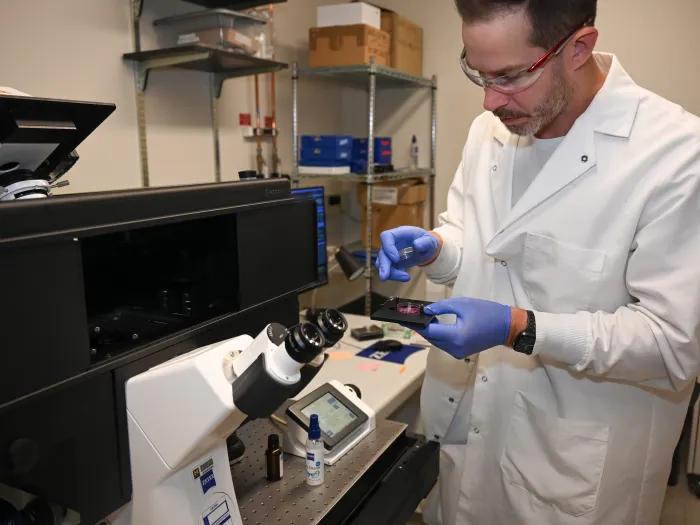
Supercharged science: New high-tech microscopes fuel brain injury research in the Emergency Medicine Department