Jason Goldstick, PhD

Manage Your Profile
About
Jason Goldstick’s past research broadly focused on social epidemiology in a variety of settings, including infectious disease, childhood problem behaviors, substance use, and violence. Inherent to these types of problems is a necessity to devise methods for complex data structures such as longitudinal and spatially dependent data, which is what brought him to this line of research during his Ph.D. training in statistics. After graduate school, Dr. Goldstick spent two years as a research fellow in the University of Michigan School of Public Health, in the Epidemiology Department, working on infectious disease modeling. Dr. Goldstick's current work at the Injury Center involves a variety of injury-related research projects, most related to substance use and/or violence. A recurring theme in his research is the analysis of how contextual information (e.g. spatially/temporally proximate conditions) modulates individual-level outcomes; both in terms of direct effects and how they modify dependencies between variables. Dr. Goldstick is the PI of an R03 funded to study age-specific risk factors for, and comorbidities of (e.g. violence, sexual risk behaviors), substance use.
Administrative Contacts
Terry Ebenhoeh
[email protected]
Lisa Orrison
[email protected]
Center Memberships
-
Center MemberInstitute for Firearm Injury Prevention
-
Center MemberInstitute for Healthcare Policy and Innovation
-
Center MemberUniversity of Michigan Injury Prevention Center
-
Center MemberOpioid Research Institute
Recent Publications
-
Seewald L, Goldstick J, Carter PM, Ngo Q, Bourque C, Pearson C, Battisti KA, Walton MA. Addictive Behaviors, 2027 Jan 1; 184:Journal ArticleDrinking, cannabis use and mental health as predictors of within-person changes in aggression over eight weeks among youth involved with binge drinking
DOI:10.1016/j.addbeh.2026.108870 PMID: 42801892 -
Ilgen M, Blow F, Piette JD, Goldstick J, Lewis M, Myers MG, Lin LA. Journal of Substance Use and Addiction Treatment, 2026 Dec 1; 191:Journal ArticleTargeting pain to improve opioid use disorder treatment outcomes: Results of a randomized trial
DOI:10.1016/j.josat.2026.210079 -
Diaz XN, Lin A, Babcock S, Salvi A, Malveau S, Mann NC, Goldstick JE, Carter PM, Cook JNB, Song X, Wei R, Lundrigan AM, Beckstead R, Hagos B, Newgard CD. Pediatrics, 2026 Oct 1; 158 (4):Journal ArticleAssociation of Community Factors, Firearm Laws, and Pediatric Firearm Injuries.
DOI:10.1542/peds.2025-074149 PMID: 42732887 -
Lee DB, Jacoby SF, Weigend Vargas E, Carter PM, Lopez Cruz A, Delgado MK, Goldstick JE. Journal of Interpersonal Violence, 2026 Sep 1; 41 (17-18): 6440 - 6461.Journal ArticleDiscrimination Experiences and Violent Injury Risk Among Young Adults
DOI:10.1177/08862605261459046 PMID: 42427003 -
Lothumalla S, Tomlinson DC, Campbell M, Jannausch M, Wilkins C, Menke N, Walton MA, Bonar EE, Goldstick J, Lin LA, Coughlin LN. Exp Clin Psychopharmacol, 2026 Aug; 34 (4): 453 - 459.Journal ArticleExploring risk tolerance among individuals who use opioids.
DOI:10.1037/pha0000844 PMID: PMC13134685 -
Larson PS, Goldstick JE, Kappelman J, Stribley SL, Jeon J, Wiebe DJ. Environmental Research, 2026 Aug 1; 302:Journal ArticleShort-term temperature and precipitation patterns associated with firearm discharge incidents in Detroit, MI, USA 2021–2025: A time-stratified case-crossover study
DOI:10.1016/j.envres.2026.124479 PMID: 42031045 -
Newgard CD, Babcock S, Malveau S, Goldstick JE, Carter PM, Cook JNB, Salvi A, Wei R, Fallat ME, Kuppermann N, Jenkins PC, Mann NC, Diaz XN, Thomas AM, Beckstead R, Hagos B, Song X. Journal of Pediatric Surgery, 2026 Mar 24;Journal ArticlePediatrics Firearm Risk Prediction in Trauma Centers and After Discharge: A Machine Learning Analysis
-
Stearns D, Carter PM, Bonar EE, Stallworth P, Delgado MK, Goldstick JE. Journal of Behavioral Medicine, 2026 Jul 1;Journal ArticleNetwork analysis of risk factors for firearm assault
Featured News & Stories
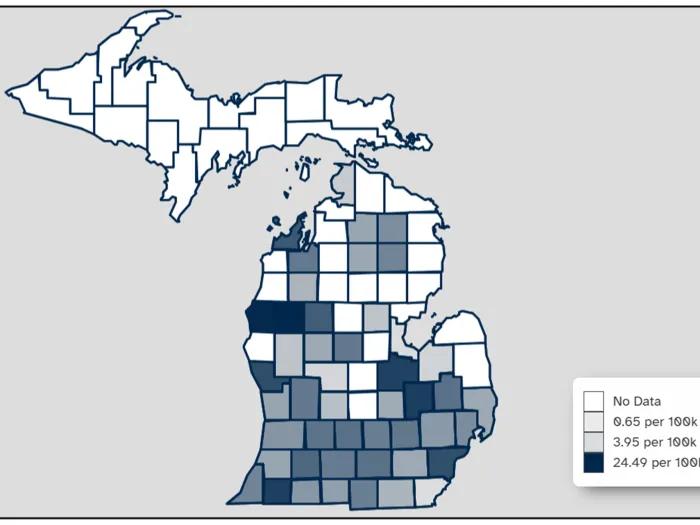
Michigan firearm data now available in near real-time

Emergency Department achieves success in faculty promotions

Celebrating a decade of discovery
Quitting menthol cigarettes is extra hard, but a new U-M study will test the best way to do it