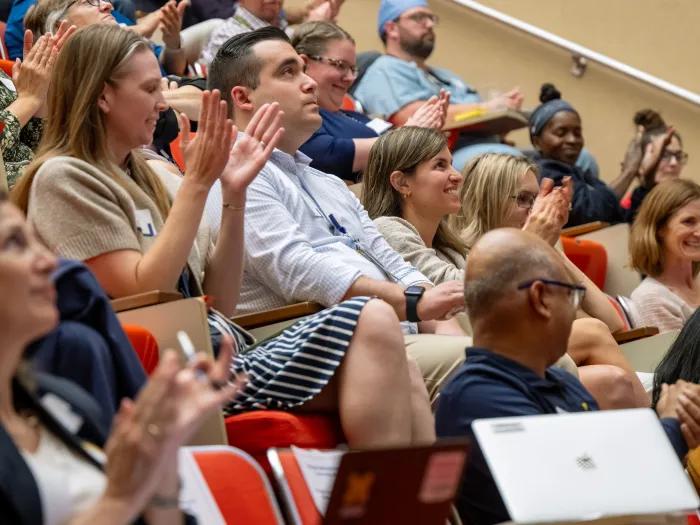
How to get into medical school
Insights from top medical school administration and current students
5:00 AM
Author |
Every medical school applicant has a plethora of questions running through their head as they apply before the deadline:
Do I have the grades, the scores and everything they’re looking for?
Will I end up where I want to go?
Will I even get in?
With thousands of applicants and no guaranteed formula for acceptance, it can be confusing to understand the admissions process and what schools are searching for in a med school applicant.
In a podcast interview (featured above), University of Michigan Medical School experts ranging from the assistant dean of admissions Deborah R. Berman, MD, and the director of admissions Carol Teener to medical students Donovan Inniss and Pratik Vadlamudi answer all your burning questions about what to expect, what medical school is like and much more.
Check out some of their answers to pre-meds’ questions from the session below.
What makes someone an ideal medical school applicant?
Berman: An ideal applicant will have shown that they have the academic chops, and the academic interest, and the drive, and the resilience, and the passion, to hunker down and study and do the work, collaborate with their classmates.
They will have curiosity. You don't come to medical school knowing everything that you need to know, but you are excited and curious and willing to again, figure out how to study, how to learn, and then somebody who really wants to contribute to medicine in a particular way, whether it's somebody who wants to be an entrepreneur, somebody who wants to practice rural clinical medicine, somebody who wants to... and then fill in the blank.
Inniss: If you are able to reflect on where you've been and where you are and where you hope to go, you can [put together] a good application.
Vadlamudi: When I was applying, I just remember thinking on the other end, "How can I make myself look like an ideal medical school applicant?" And I realized I shouldn't be making myself look like anything, I should put on the paper who I am, what I like, what I want to do, and then the school that best fits me would ideally want to accept me. And that's exactly what ended up happening.
How do medical school admissions officers weigh GPAs when considering applicants?
Berman: We look at an application holistically. We want to set people up for success.
I wouldn't say there's a particular GPA or a number that we're looking at, but rather comprehensively, how is somebody going to thrive here in our curriculum?
Teener: We don't ascribe a certain number of points for this GPA or this MCAT score or this school that you graduated from or this major or double major.
We do see everything in the portfolio. We're going to see all the coursework in every semester, whether things got a little rocky at some point, how did it go up hopefully, and the trajectory upward and how did you respond to some challenges.
What important characteristics should a potential medical school student possess?
Teener: I want to bring people into this community who also have curiosity and passion and care for others.
Berman: I'd also add altruistic; wanting to be here for true reasons, to serve human beings, committed, it is definitely a life committed to serving others…hardworking.
What types of experiences do students receive at U-M's medical school?
Vadlamudi: The first year is all about setting you up for success during your clinical year.
It teaches us to think through a patient's chief complaint, come up with a good differential diagnosis, understand what the next steps are and try to translate it to when we're actually in the clinic or hospital. We have dedicated standardized patients that allow us to practice doing the physical exam before we must do it on the real deal.
There's the clinical reasoning elective that first year students can participate in [where] they actually get to work in a hospital using the skills that they have just acquired. This really helped me when I was on the wards as a second- year student.
Inniss: We have our IPE, Inter-Professional Education, curriculum where you learn how to interact with important members of the health care team.
Also, in the doctoring curriculum, we have different conversations about not just medicine but also the social aspects of health, which are, if not more, important than the basic science of things as well.
Students from their first day of medical school also get to join in on our different organizations such as the Hope Clinic and Delonis Clinic that are serving a lot of the most underserved persons in our community before even entering your second, third or fourth clinical years.
For more advice and tips, watch and/or listen to the podcast above.
Learn more about the medical school admissions process at U-M medical school.
This podcast originally ran on Michigan Medicine Presents podcasts, a part of the Michigan Medicine Podcast Network.
Sign up for Health Lab newsletters today. Get medical tips from top experts and learn about new scientific discoveries every week by subscribing to Health Lab’s two newsletters, Health & Wellness and Research & Innovation.
Sign up for the Health Lab Podcast: Add us on Spotify, Apple Podcasts or wherever you get you listen to your favorite shows.

Health Lab
Explore thousands of health news & research stories by visiting the Health Lab homepage for more.
Media Contact
Public Relations
Department of Communication at Michigan Medicine
Stay Informed
Want top health & research news weekly? Sign up for Health Lab’s newsletters today!
Featured News & Stories
Playbook helps orthopaedic surgeons protect their most important instruments: themselves

How U-M helped bring depression out of the darkness

From the Executive Director’s Desk: November 2026
Beyond the White Coat: Disability, Neurodiversity and Advocacy in Medical School
Learning Together: Making Space for Growth at Work