Dr. Cunnane’s Michigan Answer: First in Michigan to offer the world’s smallest pacemaker

Since 1958, millions of lives have been saved by what could arguably be considered as medicine’s biggest breakthrough – the pacemaker. This single invention has not only extended lives, but has increased quality of life for its users by providing the critical electrical current needed for normal heart function.
And while its technology has dramatically improved over the last 63 years, chief concerns regarding the pacemaker have always been that it was too big and bulky and that the wires leading from it would sometimes break.
But in February of 2020, Michigan Medicine helped change all of that. Using technology so small that it could sit on a nickel, Michigan Medicine became the third hospital in the world to surgically implant the world’s tiniest pacemaker, known as the Micra AV, into a patient’s heart.
Electrophysiologist Ryan Cunnane, M.D., led Michigan’s first Micra AV procedure inside the Michigan Medicine Frankel Cardiovascular Center.
Says Dr. Cunnane, “In patients with a condition called AV block, their heart can’t conduct the needed electrical impulse to its lower chambers to produce a heartbeat. This new device is able to get that electrical connection going again.”
While the functionality of the Micra AV is certainly impressive, it’s the benefits that truly excite doctors and the patients who need them.
“There are so many advantages to this remarkable device beyond its small size,” says Dr. Cunnane. “Because it has no wires, it has far fewer complications. There’s no open- heart surgery required for insertion so patients recover much faster and with far lower rates of infection. And perhaps the best part is that since the battery can last around 11 years, patients don’t require follow-up surgery for quite some time,” says Dr. Cunnane.
Beyond being a leading center for acquiring the latest life-saving technologies for heart patients, Michigan Medicine has a reputation for having the research and expertise to implement newer technologies in ways that other places can’t. Dr. Cunnane explains more.
“Because everything we do involves using the strengths and experience of a multidisciplinary team, we’re able to achieve truly innovative results. For example, we had a young man with congenital heart disease who needed a pacemaker, but we couldn’t route the device to his heart from the leg like we normally would. Instead, we devised a way to implant the device through a vein in his neck using a catheter. This was the first time a hospital had ever done that.”
Always looking ahead to future innovations in devices and treatments, Dr. Cunnane is already involved in the next generation pacemaker, which is a fraction of this device’s size.

Health Lab
Explore thousands of health news & research stories by visiting the Health Lab homepage for more.
In This Story

Ryan T Cunnane, MD
Center Member
Featured News & Stories

AI, Well-Being and the Human Connection
Young father survives aortic dissection after delayed diagnosis
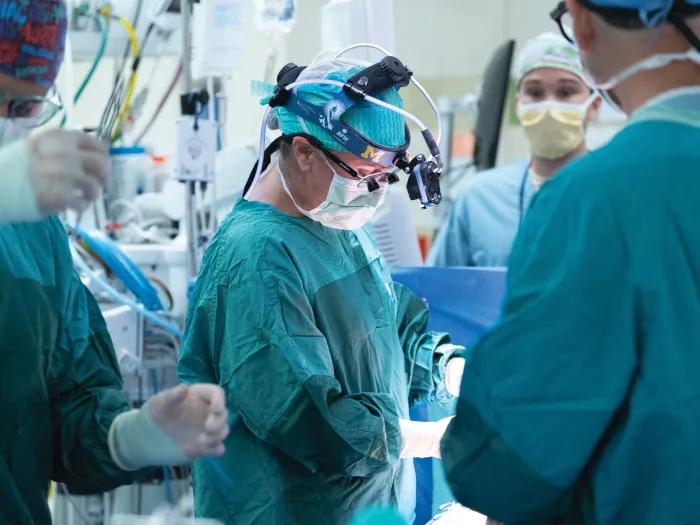
C.S. Mott Children’s Hospital first in country to implant expandable heart valve during FDA review phase

Born with half a heart, headed to college with a full life
Rethinking care: How ‘de-implementation’ can improve quality and reduce burnout